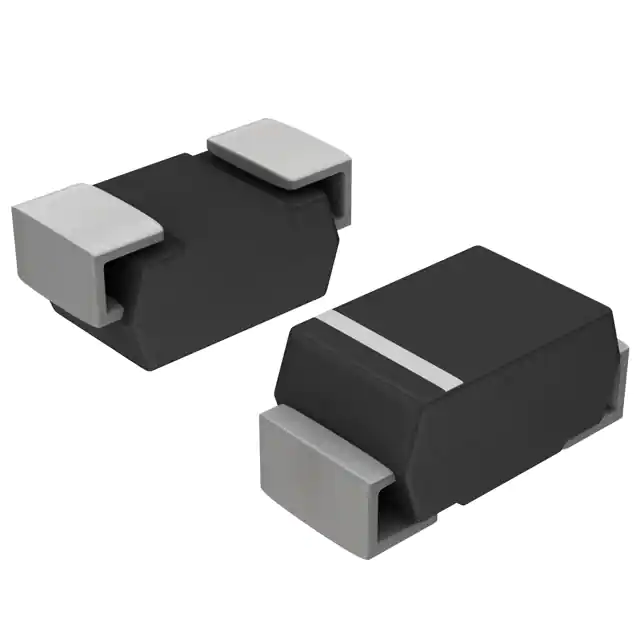
onsemi MURA140T3G

- Part No.:
- MURA140T3G
- Manufacturer:
- onsemi
- Category:
- Single Diodes
- Package:
- DO-214AC, SMA
- Datasheet:
-
 MURA140T3G.pdf
- Description:
- DIODE GEN PURP 400V 2A SMA
- Quantity:
-
Unit Price:$0
Ext Price:$0
- Payment:
-

- Shipping:
-


MURA140T3G Information
- Specifications
- Product Details
- Comparison
- Tags
- Product attributes
- Attribute value
- Manufacturer:
- onsemi
- Series:
- -
- Package/Case:
- DO-214AC, SMA
- Packaging:
- Tape & Reel (TR)
- Product Status:
- Active
- Technology:
- Standard
- Voltage - DC Reverse (Vr) (Max):
- 400 V
- Current - Average Rectified (Io):
- 2A
- Voltage - Forward (Vf) (Max) @ If:
- 1.1 V @ 1 A
- Speed:
- Fast Recovery =< 500ns, > 200mA (Io)
- Reverse Recovery Time (trr):
- 65 ns
- Current - Reverse Leakage @ Vr:
- 5 µA @ 400 V
- Capacitance @ Vr, F:
- -
- Grade:
- -
- Qualification:
- -
- Mounting Type:
- Surface Mount
- Supplier Device Package:
- SMA
- Operating Temperature - Junction:
- -65°C ~ 175°C
- Datasheet:
-
MURA140T3G.pdf
MURA140T3G — 1A 400V Ultrafast Rectifier by ON Semiconductor
The MURA140T3G is a 1A, 400V surface-mount ultrafast recovery rectifier from ON Semiconductor (onsemi). Reverse recovery time is 65ns max — not the fastest in the MURA family, but the 400V rating is the real reason engineers pick this part. It handles rectified 220VAC mains with comfortable margin, including the ringing overshoot that eats cheaper 200V diodes for breakfast.
In our Shenzhen distribution data (2025–2026), the MURA140T3G fills a specific niche: it's the go-to 1A ultrafast for universal-input auxiliary power supplies. The kind of part that sits on the primary side of a flyback converter, rectifies an auxiliary winding, and runs for a decade without anyone thinking about it. We move steady volume to industrial power supply repair shops and small-batch OEMs building offline LED drivers and metering equipment.
If you're replacing an obsolete MURA140T3 (non-RoHS predecessor), this is the direct drop-in. Same die, same package, same behavior — just lead-free and still in active production. If you're designing new and need 400V at 1A in an SMA footprint, the question isn't whether this part works. It's whether you actually need 2A and should step up to the MURA220T3G instead.
What Are the Technical Specifications of MURA140T3G?
| Parameter | Value | Notes |
|---|---|---|
| Manufacturer | ON Semiconductor (onsemi) | AEC-Q101 qualified |
| Repetitive Peak Reverse Voltage (VRRM) | 400V | — |
| Average Forward Current (IO) | 1A | At TL = 150°C |
| Peak Forward Surge Current (IFSM) | 35A | 8.3ms single half-sine |
| Max Forward Voltage (VF) | 1.1V @ 1A, 25°C | 0.89V @ 1A, TJ = 150°C |
| Reverse Recovery Time (trr) | 65ns max | IF = 0.5A, IR = 1A, IRR = 0.25A |
| Max Reverse Leakage (IR) | 5μA @ 400V, 25°C | 100μA @ 400V, 150°C |
| Package | SMA (DO-214AC) | 4.57 × 2.92 mm footprint |
| Junction Temperature Range | -65°C to +175°C | — |
| Thermal Resistance (θJA) | 216°C/W | On standard FR-4 PCB |
| ESD Rating (HBM) | >4000V (Class 3) | — |
| Soldering Temperature | 260°C max, 10s | MSL Type 1 |
| Diode Configuration | Single | Cathode band marking |
| Technology | Glass-passivated silicon PN junction | Ultrafast recovery |
Key Numbers That Matter
- 400V VRRM with 65ns recovery: There's a physics tradeoff here that the datasheet won't spell out. Higher voltage diodes need thicker, more lightly doped drift regions to block reverse voltage — which means more stored charge and slower recovery. The MURA220T3G (200V) does 35ns. The MURA140T3G (400V) does 65ns. This isn't a design flaw; it's the silicon making a deal with you. You get 2× the voltage headroom for 2× the recovery time. For universal-input off-line supplies, that's a trade worth making.
- VF drops from 1.1V to 0.89V at 150°C: The negative temperature coefficient of VF means your conduction loss decreases as the junction heats up. At 1A and 150°C junction, you're dissipating 0.89W instead of 1.1W. That 20% reduction matters when your thermal budget is tight.
- 1A rating at TL = 150°C: The 1A rating isn't a hard cliff. The lead temperature spec means the package lead (soldered to your PCB pad) can be at 150°C while the part carries 1A. On a typical board at 85°C ambient, with reasonable copper area, you can push 0.8–1A continuous. For pulsed loads, the 35A surge rating gives you plenty of transient headroom.
When Should You Use (and NOT Use) the MURA140T3G?
Use MURA140T3G when:
- Your circuit runs off rectified universal mains (85–265VAC). Rectified 265VAC gives you roughly 375V DC peak. A 200V diode has no business anywhere near that rail. The MURA140T3G's 400V rating gives you headroom for line transients and ringing, which is exactly what you need on an auxiliary winding rectifier or a start-up rail diode in an off-line supply.
- You're replacing an obsolete MURA140T3. The non-G version is dead — RoHS killed it. MURA140T3G is the official drop-in. Same SMA footprint, same 400V/1A/65ns specs, Pb-free. No layout change, no re-qualification needed.
- You need 400V but only 1A. If your load is a PWM controller VCC rail drawing 20–50mA, or a low-power bias supply under 5W, the MURA220T3G (2A) is overkill. The MURA140T3G costs less per part and, at light loads, runs cooler because its lower current rating means a smaller die with lower capacitance — less capacitive turn-on loss at high frequency.
- You need a PFC boost diode below 60W. In critical conduction mode PFC at low power, a 1A diode is enough. The 400V rating handles the PFC output voltage (typically 380–400V DC) with margin.
Don't use MURA140T3G when:
- Your steady-state current exceeds 0.8A. Derate a 1A diode to 80% for production — that gives you 0.8A. If you're pulling close to 1A continuous, the junction temperature will run high and the leakage current at 400V reverse will start to climb. Step up to the MURA220T3G (2A/200V) if your voltage allows, or the MURA260T3G (2A/600V) if you need the voltage.
- Your switching frequency is above 200kHz. At 65ns recovery, the turn-off transition represents about 1.3% of a 200kHz switching period. At 300kHz, that's 2% — and the recovery losses scale with frequency. Above 200kHz, look at SiC Schottky diodes or at least the MURA220T3G with its 35ns recovery.
- You need soft recovery for low EMI. The MURA140T3G snaps off. In a tight layout with short traces, this is fine. In a design with longer commutation loops or noise-sensitive analog nearby, the snap-off can ring. ON Semi makes a soft-recovery equivalent: the MURS140T3G. Same 400V/1A, but the turn-off current ramps down gradually instead of snapping — significantly less ringing at the cost of a slightly higher price.
- Your reverse voltage is below 150V. You're paying for 400V headroom you don't need. At 150V or below, use a 200V part like the MURA220T3G, which gives you faster recovery (35ns) and higher current (2A) at a similar price. Or, below 100V, use a Schottky — SS34 or SS54 — for even better performance.
What Are the Alternatives to MURA140T3G?
| Parameter | MURA140T3G | MURA220T3G | UF4004 | MURS140T3G |
|---|---|---|---|---|
| Manufacturer | onsemi | onsemi | Various | onsemi |
| VRRM | 400V | 200V | 400V | 400V |
| IF | 1A | 2A | 1A | 1A |
| trr | 65ns | 35ns | 50ns | 65ns (soft) |
| VF @ rated I | 1.1V | 0.95V | 1.0V | 1.25V |
| Package | SMA | SMA | DO-41 (axial) | SMB |
| AEC-Q101 | Yes | Yes | No | Yes |
| Typical Use | Off-line aux/bias | General ultrafast | Through-hole repair | Low EMI / soft recovery |
Pick MURA140T3G when: You need exactly 400V at 1A in SMA. The classic off-line auxiliary supply rectifier. It's not trying to be the fastest or the highest-current — it's the right voltage rating for the job.
Pick MURA220T3G when: Your voltage is 200V or below, or you need 2A. At 200V, the MURA220T3G has faster recovery and double the current for roughly the same price. But keep it away from rectified mains.
Pick UF4004 when: You need through-hole. The UF4004 is the axial-lead veteran of the 400V/1A ultrafast world. For prototyping on perfboard, repairing through-hole supplies, or bridging a dead SMD pad with flying leads during debug — the UF4004 is what you reach for. For production SMD, stick with MURA140T3G.
Pick MURS140T3G when: EMI compliance is tight and you can't afford the board spins to tune a snubber. The MURS140T3G's soft recovery profile reduces conducted EMI at the switching node. From our experience with industrial power supply customers, switching from MURA140 to MURS140 can cut switching-node ringing amplitude by 50–70% without adding any external components. The tradeoff: VF is slightly higher at 1.25V, and the package is SMB (slightly larger than SMA).
How Much Does MURA140T3G Cost and Is It in Stock?
| Parameter | Details |
|---|---|
| Part Number | MURA140T3G |
| Package | SMA (DO-214AC) |
| Condition | New, original ON Semiconductor (onsemi) |
| Lead Time | In stock, ship from Shenzhen |
| Packing | Tape & Reel (5000 pcs/reel) |
The MURA140T3G is a mature, high-volume part with stable pricing across ON Semi's distribution network. At production quantities, it's one of the most cost-effective ways to get a 400V-rated ultrafast rectifier in an SMA package. Contact ICMASS for current pricing on your specific quantity — we stock the full MURA series with factory-reel traceability.
What Are the Typical Applications of MURA140T3G?
Off-Line SMPS Auxiliary Winding Rectifier
This is where the majority of MURA140T3G parts end up. In a flyback converter, the auxiliary winding (the one that powers the PWM controller) typically sits at 12–24V but sees reflected primary voltage during the flyback period. The diode on this winding needs to block roughly VIN(max) × (Naux/Nprimary) plus the output voltage plus some ringing. On a universal-input design, that number can hit 300–350V. The MURA140T3G's 400V rating covers it with margin, and the 1A capability is more than enough for a controller drawing 20–50mA.
Start-Up Rail Rectifier
Before the PWM controller takes over, many off-line supplies use a start-up resistor from the rectified DC bus to charge a VCC capacitor. The rectifier diode between the auxiliary winding and the VCC capacitor is another spot where 400V reverse capability matters. The MURA140T3G handles this without drama.
PFC Boost Diode (Low Power, CrM)
In critical conduction mode PFC circuits below 60–80W, the boost diode carries the full output current during the MOSFET off-time. At 60W with 400V output, average diode current is roughly 150mA, with peak currents reaching 2–3× that. The MURA140T3G's 1A average rating and 35A surge capability handle these peaks. For CCM PFC, as discussed earlier, go SiC — the hard-switching reverse recovery in CCM will overheat any silicon ultrafast.
Snubber and Clamp Diodes
In RCD snubber and clamp networks, the diode needs to block high voltage and switch quickly but carries only transient currents. The MURA140T3G's 400V/1A/65ns combination is well-suited, and the SMA package keeps the component footprint small — important when the snubber is an afterthought squeezed into a tight layout.
Metering and Industrial Sensor Power Supplies
Smart meters, industrial sensors, and building automation devices often use capacitor-drop or small flyback supplies that run from 220VAC mains. These are low-power (1–5W), cost-sensitive designs where a 2A diode would be over-specified. The MURA140T3G fits: 400V for the line voltage, 1A is plenty for the DC output, and the SMA package suits automated assembly.
Why Buy MURA140T3G from ICMASS?
- The full MURA series in one place. MURA140T3G (400V/1A), MURA220T3G (200V/2A), MURA260T3G (600V/2A), and the MURS soft-recovery equivalents. If your design requirements shift during development — and they always do — you don't need to source from a different supplier. We carry the series end to end.
- Genuine ON Semi, traceable to the reel. Every shipment includes lot code and date code. If you're building for industrial or automotive customers who audit their supply chains, this paperwork matters. We've been through those audits — we know what to keep on file.
- Low-volume friendly. Need 20 pieces to prototype and verify before committing to reels? No problem. We'll ship same day from Shenzhen for small quantities. No minimum order, no inflated sample pricing. Try the part, test it on your board, then come back for production volumes.
- Cross-reference support. If you're trying to replace a BYG20G, GS2G, or an obsolete MURA140T3, just ask. We'll confirm pin compatibility, compare key specs, and make sure you're not about to find out about a VF mismatch the hard way. We stock Vishay, Diodes Inc, and other manufacturers, so we're not stuck pushing one brand when another fits better.
Frequently Asked Questions About MURA140T3G
Q1: What's the difference between MURA140T3G and MURA220T3G?
A: Two key differences: voltage rating and current rating. The MURA140T3G is 400V/1A with 65ns recovery; the MURA220T3G is 200V/2A with 35ns recovery. Pick MURA140T3G when your reverse voltage exceeds 200V (e.g., rectified mains circuits). Pick MURA220T3G when your voltage is below 200V and you need either more current or faster recovery. The parts are both SMA package and pin-compatible, but they are not interchangeable — putting a 200V diode on a 375V rail will fail, possibly on the first switching cycle.
Q2: Can MURA140T3G handle rectified 220VAC mains directly?
A: It depends on what you mean by "directly." Rectified 220VAC gives you roughly 311V DC peak (220 × √2). Add 10% line tolerance and you're at 342V. Add ringing overshoot from parasitic inductance and you can easily hit 380–400V. The MURA140T3G's 400V rating is just barely enough for this worst case. For production designs, derate to 80% or 320V steady-state reverse. If your circuit regularly sees peaks above 320V, step up to the MURA260T3G (600V) or the ES2J (600V). Don't run a 400V diode at 390V — you're one hot day and a line surge away from a shorted diode.
Q3: Is MURA140T3G a direct replacement for the obsolete MURA140T3?
A: Yes, direct drop-in. The MURA140T3G is the Pb-Free, RoHS-compliant version of the MURA140T3. Same silicon, same 400V/1A/65ns specs, same SMA package, same pinout. If you're maintaining a design that used the old non-RoHS part, order MURA140T3G and keep going. No layout change, no BOM re-approval needed. The only difference is the terminal finish (matte tin instead of tin-lead).
Q4: Can I use MURA140T3G as a PFC boost diode?
A: For critical conduction mode (CrM) PFC below 60W: yes. The diode current reaches zero before the MOSFET turns on, so reverse recovery is less punishing. For continuous conduction mode (CCM) PFC: no. The MOSFET turns on while the boost diode is still conducting forward current. A silicon ultrafast rectifier's reverse recovery charge becomes the dominant loss mechanism and a major EMI source. Use a SiC Schottky diode for CCM PFC. At 400V output with 1A average current, the extra cost of SiC pays back quickly in reduced heatsinking and smaller EMI filters.
Q5: How does MURA140T3G compare to UF4004?
A: Same core specs: 400V, 1A, ultrafast recovery. The key differences: UF4004 is through-hole (DO-41 axial leads), MURA140T3G is surface-mount (SMA). MURA140T3G has 65ns trr vs UF4004's 50ns — the UF4004 is slightly faster. But the MURA140T3G has better thermal performance to the PCB (SMA pad vs axial lead), and it's AEC-Q101 qualified (UF4004 is not). For new production SMD designs, use MURA140T3G. For through-hole repair or prototyping, use UF4004.
Q6: Why is MURA140T3G's reverse recovery slower than MURA220T3G's?
A: Physics. Higher-voltage silicon diodes need a thicker, more lightly doped drift region to block reverse voltage without breaking down. That thicker region stores more charge during forward conduction, and it takes longer to sweep that charge out during turn-off. The tradeoff is universal across silicon rectifier families: higher voltage = more stored charge = slower recovery. 200V gives you 35ns. 400V gives you 65ns. 600V (MURA260T3G) gives you roughly 75ns. If you need 400V but also need sub-35ns recovery, you're looking at SiC Schottky diodes, which use a different physical mechanism that eliminates stored charge entirely.
Q7: What's the through-hole equivalent of MURA140T3G?
A: UF4004 (400V/1A/50ns, DO-41 axial) or HER107 (800V/1A/75ns, DO-41). The UF4004 is the closest match on voltage and current. If you need the exact 65ns recovery spec, the MUR140 (axial DO-15 package) is the through-hole version of the same ON Semi die. But for most repair and prototyping work, UF4004 is easier to find and functionally equivalent.
Q8: Can I use MURA140T3G to replace a BYG20G or GS2G?
A: Usually yes, but check VF and current. The BYG20G (Vishay) is 400V/1.5A/75ns in SMA — slightly higher current and slower. The GS2G (MCC) is 400V/2A in SMA but is standard recovery (>500ns), not ultrafast. If the original circuit used a GS2G for 50/60Hz rectification, the MURA140T3G will work electrically but the 65ns recovery is wasted. If the original used a BYG20G in a switching circuit, the MURA140T3G is a valid substitute with slightly less current headroom. Check your actual load current before swapping — if the BYG20G was already running near its limit, the MURA140T3G might be under-rated.
Q9: Can MURA140T3G handle pulsed currents above 1A?
A: Yes. The 1A rating is for average forward current. The peak repetitive forward current rating is significantly higher, and the non-repetitive surge rating is 35A (one 8.3ms half-sine). In a typical flyback converter, the secondary diode sees peak currents 2–4× the average output current. As long as the average stays below 1A, peaks of 3–4A are well within the safe operating area. If your application involves frequent, high-energy transients (e.g., a snubber diode in a high-power converter), check the ON Semi MURA1 series I2t rating (A2s) against your worst-case transient energy.
Q10: What's the difference between MURA140T3G and MURS140T3G?
A: Both are 400V/1A ultrafast rectifiers from onsemi. The difference: MURS140T3G has soft recovery — the turn-off current ramps down gradually instead of snapping off abruptly. This dramatically reduces ringing and conducted EMI at the switching node. The MURS140T3G also comes in a slightly larger SMB package (better thermal performance) and has a slightly higher VF (1.25V vs 1.1V). Use MURA140T3G when your layout is clean and you've got snubbing under control. Use MURS140T3G when you're fighting EMI, when the layout is constrained, or when you're trying to eliminate a snubber to save BOM cost and board space.
| Image |
|
| Part Number | MURA140T3G |
| Manufacturer | onsemi |
| Series | - |
| Package/Case | DO-214AC, SMA |
| Packaging | Tape & Reel (TR) |
| Product Status | Active |
| Technology | Standard |
| Voltage - DC Reverse (Vr) (Max) | 400 V |
| Current - Average Rectified (Io) | 2A |
| Voltage - Forward (Vf) (Max) @ If | 1.1 V @ 1 A |
| Speed | Fast Recovery =< 500ns, > 200mA (Io) |
| Reverse Recovery Time (trr) | 65 ns |
| Current - Reverse Leakage @ Vr | 5 µA @ 400 V |
| Capacitance @ Vr, F | - |
| Grade | - |
| Qualification | - |
| Mounting Type | Surface Mount |
| Supplier Device Package | SMA |
| Operating Temperature - Junction | -65°C ~ 175°C |
User Guide
- Purchase & Inquiry
- Package
- Shipping Information
- Customer Review
You may place an order without registering to IC-MAX.COM
We strongly suggest you sign in before purchasing as you can track your order in real time.
For your convenience, we accept multiple payment methods in USD, including PayPal, Credit Card, and wire transfer.
RFQ (Request for Quotations)
It is recommended to request for quotations to get the latest prices and inventories about the part.
Our sales will reply to your request by email within 24 hours.
1. You'll receive an order information email in your inbox. (Please remember to check the spam folder if you didn't hear from us).
2. Since inventories and prices may fluctuate to some extent, the sales manager is going to reconfirm the order and let you know if there are any updates.
-

- Step1:Prepare product
-

- Step2:Vacuum packaging
-

- Step3:Anti-static bag
-

- Step4:Individual package
-

- Step5:Packaging box
-

- Step6:Barcode shipping label
Shipping starts at $40, but some countries will exceed $40. For example (South Africa, Brazil, India, Pakistan, Israel, etc.)
The basic freight (for package ≤0.5kg or corresponding volume) depends on the time zone and country.
Currently, our products are shipped through DHL, FedEx, SF, and UPS.
Delivery TimeOnce the goods are shipped, estimated delivery time depends on the shipping methods you chose:
FedEx International, 5-7 business days.
The following are some common countries' logistic time.

- Hot Sale
- Related Categories
- Include Parts
- Popular Search
The following parts include "MURA140T3G" in Silicon Labs MURA140T3G.
- Part Number
- Manufacturer
- Package
- Description
- 1N4448X-TP Micro Commercial Co DO-214AC, SMA DIODE GEN PURP 400V 2A SMA
- 1N4148WX-TP Micro Commercial Co DO-214AC, SMA DIODE GEN PURP 400V 2A SMA
- 1N4148TR onsemi DO-214AC, SMA DIODE GEN PURP 400V 2A SMA
- MMSD4148T1G onsemi DO-214AC, SMA DIODE GEN PURP 400V 2A SMA
- MMBD914LT3G onsemi DO-214AC, SMA DIODE GEN PURP 400V 2A SMA
- BAS16HT1G onsemi DO-214AC, SMA DIODE GEN PURP 400V 2A SMA
- 1N914BWT onsemi DO-214AC, SMA DIODE GEN PURP 400V 2A SMA
- BAS21LT1G onsemi DO-214AC, SMA DIODE GEN PURP 400V 2A SMA
- LL4148 onsemi DO-214AC, SMA DIODE GEN PURP 400V 2A SMA
- BAS16LT1G onsemi DO-214AC, SMA DIODE GEN PURP 400V 2A SMA
The following parts are popular search parts in Test and Measurement.
Inventory:18,029
Please send an inquiry. Send us your inquiry, and we will respond immediately.

- 1500+ Daily average RFQ Volume

- 20,000.000 Standard Product Unit

- 1800+ Worldwide Manufacturers

- 15,000+ In-stock Warehouse