onsemi MURA260T3G

- Part No.:
- MURA260T3G
- Manufacturer:
- onsemi
- Category:
- Single Diodes
- Package:
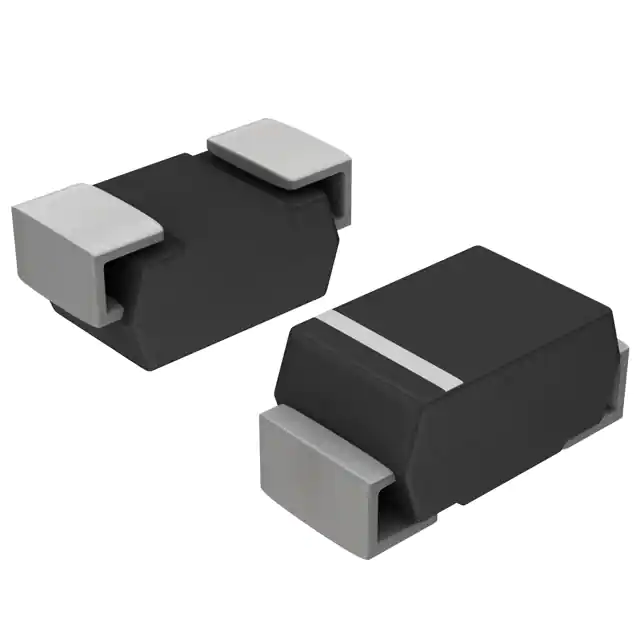
- DO-214AC, SMA
- Datasheet:
-
 MURA260T3G.pdf
- Description:
- DIODE GEN PURP 600V 2A SMA
- Quantity:
-
Unit Price:$0
Ext Price:$0
- Payment:
-

- Shipping:
-


MURA260T3G Information
- Specifications
- Product Details
- Comparison
- Tags
- Product attributes
- Attribute value
- Manufacturer:
- onsemi
- Series:
- -
- Package/Case:
- DO-214AC, SMA
- Packaging:
- Tape & Reel (TR)
- Product Status:
- Active
- Technology:
- Standard
- Voltage - DC Reverse (Vr) (Max):
- 600 V
- Current - Average Rectified (Io):
- 2A
- Voltage - Forward (Vf) (Max) @ If:
- 1.45 V @ 2 A
- Speed:
- Fast Recovery =< 500ns, > 200mA (Io)
- Reverse Recovery Time (trr):
- 75 ns
- Current - Reverse Leakage @ Vr:
- 5 µA @ 600 V
- Capacitance @ Vr, F:
- -
- Grade:
- -
- Qualification:
- -
- Mounting Type:
- Surface Mount
- Supplier Device Package:
- SMA
- Operating Temperature - Junction:
- -65°C ~ 175°C
- Datasheet:
-
MURA260T3G.pdf
MURA260T3G — 2A 600V Ultrafast Rectifier by ON Semiconductor
The MURA260T3G is a 2A, 600V surface-mount ultrafast recovery rectifier from ON Semiconductor (onsemi). If you need one number to remember: 600V. That's the highest voltage rating in the MURA SMA series, and it's the reason this part exists. When rectified 220VAC mains (311V peak) isn't your worst case — when you're dealing with 3-phase 480V systems, when the ringing on your flyback primary hits 500V+, when your PFC output sits at 400V and you want actual margin — the 200V and 400V MURA variants aren't options. This one is.
From our Shenzhen distribution data (2025–2026), the MURA260T3G serves a specific set of customers: industrial drive repair shops, solar inverter maintenance, and OEMs building off-line supplies that need to survive worst-case line surges without the diode being the weak link. It's not the fastest ultrafast (75ns trr vs MURA220's 35ns), and it's not the lowest VF (1.45V vs MURA220's 0.95V). But when the alternative is a diode that fails short on the first line transient, neither of those numbers matters.
What Are the Technical Specifications of MURA260T3G?
| Parameter | Value | Notes |
|---|---|---|
| Manufacturer | ON Semiconductor (onsemi) | AEC-Q101 qualified |
| Repetitive Peak Reverse Voltage (VRRM) | 600V | — |
| Average Forward Current (IO) | 2A | At TL = 150°C |
| Peak Forward Surge Current (IFSM) | 30A | 8.3ms single half-sine |
| Max Forward Voltage (VF) | 1.45V @ 2A, 25°C | 1.2V @ 2A, TJ = 150°C |
| Reverse Recovery Time (trr) | 75ns max | IF = 0.5A, IR = 1A, IRR = 0.25A |
| Max Reverse Leakage (IR) | 5μA @ 600V, 25°C | 100μA @ 600V, 150°C |
| Package | SMA (DO-214AC) | 4.57 × 2.92 mm footprint |
| Junction Temperature Range | -65°C to +175°C | — |
| Thermal Resistance (θJA) | 216°C/W | On standard FR-4 PCB |
| ESD Rating (HBM) | >4000V (Class 3) | — |
| Soldering Temperature | 260°C max, 10s | MSL Type 1 |
| Diode Configuration | Single | Cathode band marking |
| Technology | Glass-passivated silicon PN junction | Ultrafast recovery |
Key Numbers That Matter
- 600V VRRM with 75ns recovery: This is the third data point on the voltage-vs-speed curve we've been tracing across the MURA series. MURA220T3G: 200V/35ns. MURA140T3G: 400V/65ns. MURA260T3G: 600V/75ns. The recovery time roughly doubles from 200V to 600V, while the voltage rating triples. That's actually a good trade — the drift region doping gradient in the MURA260 is optimized to keep recovery time in check despite the high blocking voltage. At 75ns, you're still firmly in ultrafast territory, perfectly usable at 65–130kHz switching frequencies with proper layout.
- VF = 1.45V at 2A (1.2V at 150°C): This is the price of admission for 600V blocking. At 2A, you're dissipating 2.9W at room temperature and 2.4W at operating temperature. Compare that to MURA220T3G's 1.9W at 2A — the MURA260 runs about 50% hotter at the same current. If your thermal budget is tight, this number matters more than the voltage rating. Make sure you've got the copper area to handle it.
- 30A IFSM (vs 40A for MURA220, 35A for MURA140): The surge current rating drops as voltage rating rises, because the higher-voltage die has higher thermal impedance during the surge pulse. 30A is still plenty for a 2A-rated part — it's 15× the continuous rating. But if your design has unusually high inrush (e.g., charging a large bulk capacitor through the diode), model the I2t energy against the MURA260's rating before assuming it'll survive.
When Should You Use (and NOT Use) the MURA260T3G?
Use MURA260T3G when:
- Your worst-case reverse voltage exceeds 350V. Rectified 265VAC is 375V DC. Add ringing, line surges, and transformer leakage spike reflection, and you're routinely north of 450V on the secondary rectifier of an off-line flyback. The MURA140T3G at 400V is cutting it too close. The MURA260T3G at 600V gives you the headroom to stop worrying about voltage margin and start worrying about something else.
- You're working with 3-phase rectification. A 3-phase 480V line gives you roughly 680V DC after rectification. Neither the MURA220T3G (200V) nor the MURA140T3G (400V) can even look at this rail. The MURA260T3G at 600V is still marginal for direct 480V 3-phase rectification — for that you'd want 800–1000V parts — but it handles the auxiliary and control supplies that tap off phase-to-neutral (277V RMS = 392V peak) with margin to spare.
- You're replacing a failed 600V ultrafast in a repair job. The MURA260T3G is a common drop-in for failed UF4007, MUR260, BA158, and BYV26-series diodes in SMPS repairs, as long as the original was in an SMA-compatible footprint. Check the original package — if it was axial (DO-41), you'll need to adapt the layout or use an axial part.
- Your design must survive IEC 61000-4-5 surge testing. The 1.2/50μs combination wave surge test can push the rectified DC bus hundreds of volts above nominal. A 400V diode on a 311V nominal bus has less than 90V of surge headroom — that's gone in the first microsecond of a 1kV surge. The MURA260T3G's 600V rating buys you nearly 300V of headroom, which often means the difference between "diode survived" and "replace the diode and the MOSFET behind it."
Don't use MURA260T3G when:
- Your reverse voltage is below 300V. You're paying the VF penalty (1.45V vs 0.95V) for voltage headroom you don't need. At 2A load, that extra 0.5V costs you 1W of extra heat per diode. Use the MURA220T3G instead — same current, same package, half the conduction loss.
- You need switching frequencies above 150kHz. At 75ns recovery, the turn-off loss starts to dominate above 150kHz. The MURA220T3G at 35ns can push to 250–300kHz before recovery losses become the bottleneck. If you need 600V and high frequency, you're looking at SiC Schottky diodes (e.g., C3D02060E from Wolfspeed, or the IDH02G65C5 from Infineon) — zero reverse recovery, 600V+ rating, 3–5× the cost.
- Your continuous current is above 1.5A (small PCB) or 2A (any PCB). At 2A and 1.45V VF, you're dissipating 2.9W. On a standard SMA pad with minimal copper, θJA of 216°C/W gives a 626°C rise — obviously impossible before the part self-destructs. Even with generous 2cm² copper area (θJA ≈ 60–80°C/W), you're looking at a 175–230°C rise above ambient. At 2A continuous, use a larger package: the MURS260T3G in SMB, or step up to a DPAK (TO-252) device with a proper thermal pad.
- You need soft recovery for low-noise designs. Like the rest of the MURA series, the MURA260T3G has standard ultrafast recovery — it snaps off. At 600V with the larger stored charge that comes with high-voltage silicon, the snap-off energy is significant. If EMI is a concern, use the MURS260T3G (soft recovery, SMB package) or add a properly tuned RC snubber across each diode.
What Are the Alternatives to MURA260T3G?
| Parameter | MURA260T3G | ES2J | UF4007 | MURS260T3G |
|---|---|---|---|---|
| Manufacturer | onsemi | Various | Various | onsemi |
| VRRM | 600V | 600V | 1000V | 600V |
| IF | 2A | 2A | 1A | 2A |
| trr | 75ns | 35ns | 75ns | 75ns (soft) |
| VF @ rated I | 1.45V | 1.7V | 1.7V | 1.45V |
| Package | SMA | SMA (DO-214AC) | DO-41 (axial) | SMB |
| AEC-Q101 | Yes | No | No | Yes |
| Typical Use | General high-voltage | High-speed 600V | Through-hole repair | Low EMI / soft recovery |
Pick MURA260T3G when: You want a 600V/2A ultrafast in SMA with AEC-Q101 pedigree and balanced VF-vs-speed performance. The Goldilocks choice for off-line SMPS secondary rectification where 400V isn't enough but 1000V is overkill.
Pick ES2J when: You need speed more than efficiency. The ES2J has 35ns recovery at 600V — half the MURA260's 75ns — but pays for it with 1.7V VF (vs 1.45V). At 2A, that's 3.4W of conduction loss vs 2.9W. If your switching frequency is above 150kHz, the recovery loss savings may outweigh the conduction penalty. Below 100kHz, the MURA260 runs cooler.
Pick UF4007 when: You need through-hole and 1A is enough. The UF4007 is rated 1000V/1A with 75ns recovery — higher voltage, half the current. It's the universal through-hole ultrafast for repair work and prototyping. For production SMD, MURA260T3G is the surface-mount equivalent with double the current.
Pick MURS260T3G when: You're willing to trade package size (SMB vs SMA) for cleaner switching. The MURS260T3G's soft recovery characteristic meaningfully reduces turn-off ringing amplitude without requiring external snubber components. From our experience, engineers who switch from MURA260 to MURS260 in tightly-packed industrial power supplies typically see a 5–8dB improvement in conducted EMI at the switching frequency harmonics. That can be the difference between passing EN 55032 Class B on the first pass and spending two weeks iterating the input filter.
How Much Does MURA260T3G Cost and Is It in Stock?
| Parameter | Details |
|---|---|
| Part Number | MURA260T3G |
| Package | SMA (DO-214AC) |
| Condition | New, original ON Semiconductor (onsemi) |
| Lead Time | In stock, ship from Shenzhen |
| Packing | Tape & Reel (5000 pcs/reel) |
The MURA260T3G is a mature production part with stable supply. At the 600V rating, it sits at an interesting price point: more expensive than the 200V MURA220T3G (more silicon area for the higher-voltage die), but significantly less than a SiC Schottky at the same voltage. For designs where 600V is non-negotiable but the budget doesn't stretch to SiC, this is where you land. Contact ICMASS for current pricing on your quantity — we stock the full MURA/MURS range from ON Semi with factory traceability.
What Are the Typical Applications of MURA260T3G?
Off-Line SMPS Output Rectification
In a universal-input flyback converter (85–265VAC), the secondary rectifier sees a reverse voltage of VOUT + VIN(max) × (NS/NP). For a 12V output from a 265VAC input with a typical 10:1 primary-to-secondary turns ratio, that's roughly 12 + 375/10 = 49.5V — well within any diode's rating. But add leakage inductance ringing that can double the reflected voltage during the turn-off spike, and a 200V diode on a poorly-snubbered secondary can see brief peaks near 150–200V. The MURA260T3G's 600V rating isn't needed for 12V outputs — but for 24V and 48V output designs, especially multi-output supplies where one secondary rectifier sees the combined reflected voltage of multiple windings, the extra margin earns its keep.
PFC Boost Diode (CrM, 100–200W)
In critical conduction mode PFC, the boost diode blocks the full output voltage (typically 380–400V) plus any ringing during the MOSFET turn-on transition. At 100–200W, the average diode current is 250–500mA, with peak currents of 1.5–3A. The MURA260T3G's 2A average rating and 600V blocking voltage cover these conditions. For CCM PFC at these power levels, as with the other MURA parts, go SiC — the hard-switching reverse recovery in CCM will push the MURA260 past its thermal limit.
Industrial Motor Drive Snubber and Freewheeling
In VFD (variable frequency drive) and servo drive output stages, the freewheeling diodes across IGBTs see the full DC bus voltage (typically 300–400V for 220VAC-class drives, 550–750V for 480VAC-class drives). For the 220V class, the MURA260T3G at 600V works in snubber and auxiliary supply positions. For the 480V class, the bus voltage alone exceeds 600V — step up to 1000–1200V devices for the main freewheeling and snubber positions.
Solar Micro-Inverter and Power Optimizer
Panel-level power electronics operate at 20–60V DC input but need to block the full string voltage under fault conditions. In a micro-inverter with a 60V panel input, the output rectifier needs to block the grid-tie voltage (up to 400V DC bus) during anti-islanding events. The MURA260T3G's 600V rating provides margin for these fault conditions, and the SMA package fits the tight volumetric constraints of under-panel electronics.
HVAC and Appliance Control Boards
Air conditioner inverter boards, washing machine motor drives, and heat pump controllers all run off rectified mains and need auxiliary power supplies that are compact, reliable, and cheap. The MURA260T3G in these applications typically sits on the primary-side auxiliary winding rectifier or the start-up rail diode. The key requirement: survive power line surges and lightning-induced transients without failing short and taking out the PWM controller downstream. The 600V rating buys the surge immunity that cheaper 400V diodes don't.
Why Buy MURA260T3G from ICMASS?
- We stock the full voltage ladder. MURA220T3G (200V), MURA140T3G (400V), MURA260T3G (600V), plus the MURS soft-recovery equivalents at each voltage. If your design evolves from 12V output to 48V, or from domestic mains to 3-phase industrial, your diode supplier doesn't change — just the part number.
- Genuine ON Semi, every reel. At the 600V end of the ultrafast market, counterfeits are a real problem. A remarked 400V die in a package labeled "600V" will work fine on the bench and fail in the field six months later. Every MURA260T3G we ship is traceable to the ON Semiconductor factory reel. We'll provide lot codes and date codes with your order — no extra charge, no special request needed.
- Same-day samples, no minimum. Want to characterize the MURA260T3G's reverse recovery on your specific layout before committing to production quantities? Order 10 or 20 pieces. We'll ship same day from Shenzhen. No sample fee, no inflated small-quantity pricing.
- Applications support included. Not sure whether MURA260T3G, MURS260T3G, or SiC is the right call for your 600V design? Tell us your topology, switching frequency, and target efficiency. We'll give you a straight answer — not the one that maximizes our margin. We carry SiC too, and we'd rather sell you the right part once than the wrong part three times.
Frequently Asked Questions About MURA260T3G
Q1: How does MURA260T3G differ from MURA220T3G and MURA140T3G?
A: It's the 600V member of the MURA SMA trio, sitting above MURA140T3G (400V/1A/65ns) and MURA220T3G (200V/2A/35ns). Key tradeoffs vs MURA220T3G: 3× the voltage rating (600V vs 200V), but 50% higher VF (1.45V vs 0.95V) and 2× slower recovery (75ns vs 35ns). Same package (SMA), same 2A rating. Pick MURA260T3G when reverse voltage exceeds 350V. Pick MURA220T3G for everything below 200V where you want the best efficiency.
Q2: Can MURA260T3G replace ES2J?
A: In most cases, yes — with a tradeoff. Both are 600V/2A SMA ultrafast rectifiers. ES2J has faster recovery (35ns vs 75ns) but higher VF (1.7V vs 1.45V). If your switching frequency is below 100kHz, the MURA260T3G will run cooler because conduction losses dominate. If your switching frequency is above 150kHz, the ES2J's faster recovery pays off in reduced switching loss. Above 200kHz, neither part is ideal — go SiC.
Q3: Is there a through-hole equivalent?
A: MUR260 (DO-15 axial, 600V/2A/75ns) is the direct through-hole equivalent from onsemi. UF4007 (DO-41 axial, 1000V/1A/75ns) is close on voltage and speed but half the current. For repair work on through-hole boards, MUR260 is the correct replacement. For new designs, stay with MURA260T3G in SMD — the SMA package has better thermal performance and lower lead inductance.
Q4: What copper area do I need for 2A continuous operation?
A: At 2A with 1.45V VF, you're dissipating 2.9W. With standard 1oz copper, you need roughly 4–5cm² of contiguous copper area on the cathode pad to keep the junction below 150°C at 85°C ambient. With 2oz copper, 2–3cm² is usually sufficient. If you can't dedicate that much area, either derate the current to 1–1.2A, or use the MURS260T3G in SMB which has a larger lead frame and better heat spreading. A quick rule of thumb from our lab: if you can't keep your finger on the PCB near the diode after 30 seconds of full-load operation, the junction is probably too hot.
Q5: Can MURA260T3G handle a 3-phase 480V rectifier?
A: Not for the main rectification. 3-phase 480V AC rectifies to roughly 680V DC peak. The MURA260T3G's 600V rating is below this. For the main 3-phase bridge, you need 1000–1200V diodes. The MURA260T3G is suitable for auxiliary supplies tapped off a single phase (277V RMS = 392V peak) or for the control power supply derived from the DC bus through a flyback converter, where the secondary-side rectifier sees a fraction of the full bus voltage.
Q6: Does MURA260T3G need a snubber?
A: At 600V, the stored charge during forward conduction is larger than lower-voltage ultrafast diodes, so the turn-off snap is more energetic. In most off-line SMPS applications above 30W, plan for an RC snubber. Start with 100–220pF + 100–220Ω directly across the diode, measure the ringing frequency and amplitude with a scope, and tune. If your PCB layout has short (<10mm) commutation loops and you're using a ground plane, you may be able to omit the snubber. If the loop is longer or you're on a 2-layer board, budget the snubber footprint from the start — adding it after EMC testing is much harder than leaving the pads unpopulated if they're not needed.
Q7: How does reverse leakage behave at high temperature?
A: The reverse leakage current spec is 5μA at 25°C and 100μA at 150°C — a 20× increase. At 175°C (the absolute maximum junction temperature), expect leakage to reach 200–500μA. This matters in two scenarios: (1) high-ambient designs where the diode runs hot continuously — leakage current becomes a measurable fraction of the load current in light-load conditions; (2) blocking voltage derating — at 175°C, the 600V rating is not practically achievable because leakage-induced self-heating creates thermal runaway before you reach 600V. For reliable operation at high junction temperatures, derate the reverse voltage to 80% (480V).
Q8: What's the difference between MURA260T3G and MURS260T3G?
A: Both are 600V/2A/75ns ultrafast rectifiers from onsemi. The MURS260T3G adds soft recovery — the turn-off current ramps down gradually, reducing ringing and EMI. It comes in a larger SMB package with better thermal performance. Use MURA260T3G when your layout is clean and you can fit a snubber. Use MURS260T3G when you're space-constrained (eliminate the snubber), when EMI compliance is critical, or when you're doing a board respin specifically to fix conducted emissions. The soft recovery characteristic is the kind of thing that doesn't matter — until you're in the EMC chamber at 2AM and it suddenly matters a lot.
| Image |
|
| Part Number | MURA260T3G |
| Manufacturer | onsemi |
| Series | - |
| Package/Case | DO-214AC, SMA |
| Packaging | Tape & Reel (TR) |
| Product Status | Active |
| Technology | Standard |
| Voltage - DC Reverse (Vr) (Max) | 600 V |
| Current - Average Rectified (Io) | 2A |
| Voltage - Forward (Vf) (Max) @ If | 1.45 V @ 2 A |
| Speed | Fast Recovery =< 500ns, > 200mA (Io) |
| Reverse Recovery Time (trr) | 75 ns |
| Current - Reverse Leakage @ Vr | 5 µA @ 600 V |
| Capacitance @ Vr, F | - |
| Grade | - |
| Qualification | - |
| Mounting Type | Surface Mount |
| Supplier Device Package | SMA |
| Operating Temperature - Junction | -65°C ~ 175°C |
User Guide
- Purchase & Inquiry
- Package
- Shipping Information
- Customer Review
You may place an order without registering to IC-MAX.COM
We strongly suggest you sign in before purchasing as you can track your order in real time.
For your convenience, we accept multiple payment methods in USD, including PayPal, Credit Card, and wire transfer.
RFQ (Request for Quotations)
It is recommended to request for quotations to get the latest prices and inventories about the part.
Our sales will reply to your request by email within 24 hours.
1. You'll receive an order information email in your inbox. (Please remember to check the spam folder if you didn't hear from us).
2. Since inventories and prices may fluctuate to some extent, the sales manager is going to reconfirm the order and let you know if there are any updates.
-

- Step1:Prepare product
-

- Step2:Vacuum packaging
-

- Step3:Anti-static bag
-

- Step4:Individual package
-

- Step5:Packaging box
-
- Step6:Barcode shipping label
Shipping starts at $40, but some countries will exceed $40. For example (South Africa, Brazil, India, Pakistan, Israel, etc.)
The basic freight (for package ≤0.5kg or corresponding volume) depends on the time zone and country.
Currently, our products are shipped through DHL, FedEx, SF, and UPS.
Delivery TimeOnce the goods are shipped, estimated delivery time depends on the shipping methods you chose:
FedEx International, 5-7 business days.
The following are some common countries' logistic time.

- Hot Sale
- Related Categories
- Include Parts
- Popular Search
The following parts include "MURA260T3G" in Silicon Labs MURA260T3G.
- Part Number
- Manufacturer
- Package
- Description
- 1N4448X-TP Micro Commercial Co DO-214AC, SMA DIODE GEN PURP 600V 2A SMA
- 1N4148WX-TP Micro Commercial Co DO-214AC, SMA DIODE GEN PURP 600V 2A SMA
- 1N4148TR onsemi DO-214AC, SMA DIODE GEN PURP 600V 2A SMA
- MMSD4148T1G onsemi DO-214AC, SMA DIODE GEN PURP 600V 2A SMA
- MMBD914LT3G onsemi DO-214AC, SMA DIODE GEN PURP 600V 2A SMA
- BAS16HT1G onsemi DO-214AC, SMA DIODE GEN PURP 600V 2A SMA
- 1N914BWT onsemi DO-214AC, SMA DIODE GEN PURP 600V 2A SMA
- BAS21LT1G onsemi DO-214AC, SMA DIODE GEN PURP 600V 2A SMA
- LL4148 onsemi DO-214AC, SMA DIODE GEN PURP 600V 2A SMA
- BAS16LT1G onsemi DO-214AC, SMA DIODE GEN PURP 600V 2A SMA
The following parts are popular search parts in Test and Measurement.
Inventory:13,472
Please send an inquiry. Send us your inquiry, and we will respond immediately.

- 1500+ Daily average RFQ Volume

- 20,000.000 Standard Product Unit

- 1800+ Worldwide Manufacturers

- 15,000+ In-stock Warehouse