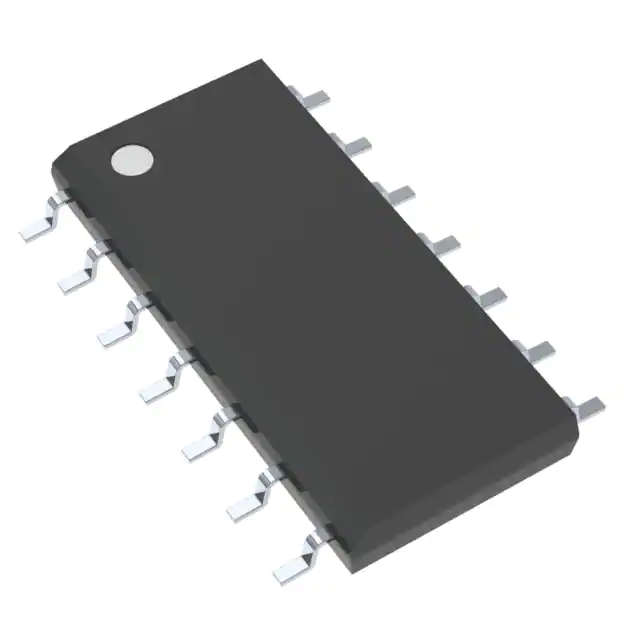
Texas Instruments LM324DR

- Part No.:
- LM324DR
- Manufacturer:
- Texas Instruments
- Category:
- Instrumentation, Op Amps, Buffer Amps
- Package:
- 14-SOIC (0.154", 3.90mm Width)
- Datasheet:
-
 LM324DR.pdf
- Description:
- IC OPAMP GP 4 CIRCUIT 14SOIC
- Quantity:
-
Unit Price:$0
Ext Price:$0
- Payment:
-

- Shipping:
-


LM324DR Information
- Specifications
- Product Details
- Comparison
- Tags
- Product attributes
- Attribute value
- Manufacturer:
- Texas Instruments
- Series:
- -
- Package/Case:
- 14-SOIC (0.154", 3.90mm Width)
- Packaging:
- Tape & Reel (TR)
- Product Status:
- Active
- Amplifier Type:
- General Purpose
- Number of Circuits:
- 4
- Output Type:
- -
- Slew Rate:
- 0.5V/µs
- Gain Bandwidth Product:
- 1.2 MHz
- -3db Bandwidth:
- -
- Current - Input Bias:
- 20 nA
- Voltage - Input Offset:
- 3 mV
- Current - Supply:
- 1.4mA (x4 Channels)
- Current - Output / Channel:
- 30 mA
- Voltage - Supply Span (Min):
- 3 V
- Voltage - Supply Span (Max):
- 30 V
- Operating Temperature:
- 0°C ~ 70°C (TA)
- Grade:
- -
- Qualification:
- -
- Mounting Type:
- Surface Mount
- Supplier Device Package:
- 14-SOIC
- Datasheet:
-
LM324DR.pdf
LM324DR — Quad Operational Amplifier from Texas Instruments
The LM324DR is a quad operational amplifier in a 14-pin SOIC package — four independent op-amps that run from a single 3V–32V supply or dual ±1.5V–±16V rails. Gain-bandwidth product is 1.2MHz, slew rate is 0.5V/µs, and total supply current for all four channels is just 1.4mA — that's 175µA per amplifier.
The input common-mode range includes ground. On a single 5V rail, you can sense signals all the way down to 0V without a negative supply. That one feature is why this part has been in continuous production since 1972 — per the TI datasheet, it's still the default choice for low-speed sensor interfaces, active filters, and control loops where you just need an op-amp that works.
What Are the Technical Specifications of LM324DR?
| Parameter | Value |
|---|---|
| Number of Op-Amps | 4 |
| Package | SOIC-14 (8.65mm × 3.90mm) |
| Gain-Bandwidth Product (GBWP) | 1.2MHz typ |
| Slew Rate | 0.5V/µs typ |
| Input Offset Voltage (Vos) | 3mV typ, 7mV max |
| Input Offset Voltage Drift | 7µV/°C |
| Input Bias Current (Ib) | 20nA typ, 250nA max |
| Input Offset Current (Ios) | 2nA typ, 50nA max |
| CMRR | 80dB typ |
| Input Voltage Noise Density | 35nV/√Hz @ 1kHz |
| Supply Voltage (Single) | 3V to 32V |
| Supply Voltage (Dual) | ±1.5V to ±16V |
| Quiescent Current (per channel) | 175µA typ |
| Quiescent Current (total, 4 channels) | 1.4mA typ |
| Output Current per Channel | 20mA min, 40mA typ |
| Output Voltage Swing (High) | Vcc – 1.5V typ |
| Output Voltage Swing (Low) | 5mV typ (light load) |
| Open-Loop Voltage Gain | 100dB typ (100V/mV) |
| Operating Temperature | 0°C to 70°C |
Key numbers that matter: The 1.2MHz GBWP means at a gain of 10, you get 120kHz of usable bandwidth. At unity gain, 1.2MHz — but only for small signals. The 0.5V/µs slew rate limits large-signal swing to about 16kHz at 10Vpp. Beyond that, your sine waves turn into triangle waves. The 175µA per channel is low enough for battery-powered designs that run continuously, and the 20nA input bias current means you can use 100kΩ+ resistors in your feedback network without significant offset error.
What Are the Alternatives to LM324DR?
| Model | Manufacturer | Key Difference | Best For |
|---|---|---|---|
| LM324B | Texas Instruments | 36V supply, ±3mV offset max, 2kV ESD, built-in EMI filters | New designs, drop-in upgrade |
| LM2902DR | Texas Instruments | –40°C to +125°C, same pinout and specs | Industrial/automotive |
| LM324DT | STMicroelectronics | 1.3MHz GBWP, direct drop-in | European supply chain |
| LM358DR | Texas Instruments | Same specs, 2 channels, SOIC-8 | When you only need 2 op-amps |
| TL074CDR | Texas Instruments | JFET input, 3MHz GBWP, 13V/µs slew, 30pA Ib | Audio, high-speed circuits |
| MCP6004-I/SL | Microchip | Rail-to-rail I/O, 1MHz GBWP, 100µA/ch | Low-voltage battery devices |
LM324DR vs LM324B — should you upgrade? The LM324B is TI's next-gen version of the same chip. Supply goes to 36V, offset drops to ±3mV max, ESD rating jumps from 500V to 2kV, and there are built-in EMI filters on the inputs — which matters if your op-amp sits near a switching converter. Still SOIC-14, still pin-compatible, still the same price ballpark. Per TI's SLOP415 application note, the B version is a direct upgrade with no downsides. If you're spinning a new PCB, there's no reason to design in the original LM324 over the LM324B — unless you've already qualified the LM324 and don't want to re-qualify.
LM324DR vs TL074 — when does the 1972 design show its age? The TL074 uses JFET inputs instead of bipolar. Input bias current drops from 20nA to 30pA — three orders of magnitude. GBWP jumps from 1.2MHz to 3MHz, slew rate from 0.5V/µs to 13V/µs. For audio, instrumentation, or anything above a few kHz, the TL074 is the better op-amp and costs about the same. But here's the thing: the TL074's JFET inputs need about 3V of headroom from the negative rail, while the LM324's inputs work all the way down to ground. On a single 5V supply, the TL074 can't sense signals below 3V. The LM324 can sense all the way to 0V. That's the trade-off.
How Much Does LM324DR Cost and Is It in Stock?
| Quantity | TI LM324DR (per unit) | onsemi LM324DR2G (per unit) |
|---|---|---|
| 1–49 | $0.12–$0.20 | $0.10–$0.18 |
| 50–999 | $0.08–$0.12 | $0.06–$0.10 |
| 1,000–4,999 | $0.06–$0.08 | $0.04–$0.06 |
| 5,000+ (full reel) | $0.04–$0.06 | $0.03–$0.05 |
The LM324 is one of the highest-volume op-amps ever made. Global inventory across TI, onsemi, and ST is in the millions of units. No allocation risk, no shortage. The LM324B (TI's upgraded version) costs about 10–20% more. Lead time for standard quantities: 2–5 business days. Contact us for a same-day quote on your specific quantity.
What Are the Typical Applications of LM324DR?
Sensor Signal Conditioning: The ground-sensing input makes the LM324 ideal for current shunts, thermocouples, and photodiode amplifiers on single-supply rails. You can bias the input at ground and still get a valid output. Per the TI datasheet, this was the feature that made the LM324 dominant in the 1970s — and it's still the main reason to pick it today. Most modern rail-to-rail op-amps can't actually sense below 50mV from ground.
Active Filters (Low-Pass, Band-Pass): At 1.2MHz GBWP, you can build Sallen-Key filters up to about 20kHz before the op-amp runs out of loop gain. Below 10kHz, it's completely adequate. Four op-amps in one package means you can cascade a 4th-order filter with a single chip — two 2nd-order stages, one SOIC-14.
Voltage Follower / Buffer: Unity-gain stable with no external compensation needed. High input impedance, low output impedance, stable driving resistive loads. Just don't hang a long cable or a big capacitor directly on the output pin — that's the #1 cause of unexpected oscillation.
Current-Sense Amplifier (Low-Side): Configure as a differential amplifier across a shunt resistor on the ground return. The ground-sensing input means this is the simplest current-sense topology — no level shifting, no auxiliary supplies. At 35nV/√Hz the noise is modest, but for 8–10 bit ADC applications it's perfectly adequate.
Window Comparator (Slow Signals Only): Yes, you can use an op-amp as a comparator. No, the LM324 is not a good one. Recovery from saturation takes 10µs+ because the op-amp is internally compensated for linear operation. But for slow threshold detection — mains zero-crossing, temperature limits, battery low-voltage alarms — it works fine and saves you a separate comparator chip. For anything that needs speed, use an LM339DR.
Why Buy LM324DR from ICMASS?
Genuine TI and onsemi parts from authorized distribution. Every reel comes with full lot code and date code traceability. No gray market, no refurbished re-marked parts. In our experience sourcing op-amps in Shenzhen, the LM324 is counterfeited less often than MOSFETs, but we still test incoming lots — a fake LM324 with 700kHz GBWP instead of 1.2MHz will send your filter design straight to the debug bench.
Shenzhen warehouse, same-day shipping. Orders placed before 15:00 CST ship same day. Next-day delivery to Shenzhen/Guangzhou. 2–3 days rest of China. International via DHL/FedEx: 5–10 days.
BOM consolidation. Alongside the LM324DR, we stock comparators (LM339DR), dual op-amps (LM358DR), MOSFETs, LDOs, and diodes. One order, one shipment, one invoice.
Cross-reference support included. LM324B, LM2902, or TL074? Tell us your voltage, temperature, and bandwidth requirements — we'll recommend the right part.
Frequently Asked Questions About LM324DR
Q1: Why does my LM324 oscillate when I connect it to a long cable or capacitive load?
A: The LM324's output stage isn't designed for capacitive loads. A capacitor on the output creates a pole in the feedback loop that eats into phase margin. Fix: add a 100Ω–1kΩ isolation resistor between the output pin and the load, then route the feedback path from the load side of that resistor. For stubborn cases, add a small capacitor (100pF–1nF) from output to inverting input to tighten the local AC feedback. This is the single most common LM324 problem, confirmed across hundreds of threads on the TI E2E forum and StackExchange.
Q2: Why does my LM324 produce a glitch or flat spot near zero volts?
A: Crossover distortion — it's by design. The LM324 uses a Class B output stage. When the output crosses zero, both the pull-up and pull-down transistors are momentarily off, creating a dead zone. Fix: add a pull-down resistor (1kΩ–10kΩ) from output to ground (or V– in dual-supply). This forces the upper transistor to stay on all the time — Class A operation, no dead zone. The trade-off is higher quiescent current. For new audio designs, just use a TL074 instead. Same price, no crossover distortion, lower noise.
Q3: Can I use LM324 as a comparator?
A: You can, but it'll be slow. The LM324 takes 10µs or more to recover from saturation because it's internally compensated for linear operation. A real comparator like the LM339DR recovers in under 2µs. Use the LM324 for slow threshold detection — mains zero-crossing, temperature alarms, battery warnings — where speed doesn't matter. For anything faster, use an actual comparator.
Q4: What's the maximum frequency the LM324 can handle?
A: With 1.2MHz GBWP and 0.5V/µs slew rate, the ceiling depends on what you're doing. Gain-of-10 amplifier: 120kHz bandwidth. Unity-gain buffer: 1.2MHz small-signal, but large-signal bandwidth drops to about 30kHz because of slew rate limiting. For a sine wave at full swing (10Vpp): about 16kHz. Above that, sines turn into triangles, then collapse.
Q5: LM324 vs LM358 — what's the difference?
A: Same silicon, different package. The LM358 is the dual version (SOIC-8, 2 op-amps); the LM324 is the quad version (SOIC-14, 4 op-amps). Per-channel specs are identical: same GBWP, same slew rate, same bias current. Pick the LM358 when you need 1–2 op-amps and board space matters. Pick the LM324 when you need 3–4 and want a single chip. Two LM358s cost slightly more than one LM324 at volume.
Q6: Can I replace LM324DR with STMicroelectronics LM324DT?
A: Yes, direct drop-in. The ST version actually has a slightly higher GBWP — 1.3MHz vs. 1.2MHz for TI — which is an upgrade, not a problem. Many manufacturers dual-source both on the same BOM.
Q7: How should I handle unused op-amp channels on the LM324?
A: Configure each unused channel as a voltage follower: connect the output directly to the inverting (–) input, and tie the non-inverting (+) input to a mid-supply reference (Vcc/2, using a resistor divider). Leave the output unconnected. This biases the amplifier in its linear region — stable, no oscillation, no excessive current draw. Never leave unused inputs floating. Never tie both inputs directly to ground or Vcc. Per TI's application note SLOA067, this is the correct way to terminate unused op-amps.
Q8: Why can't my LM324 output reach the positive rail on a single supply?
A: It's not a rail-to-rail op-amp. The output swings to within about 1.5V of the positive rail at room temperature — more like 2V over the full temperature range. On a 5V supply, expect about 3.5V max output. On 3.3V, you're down to roughly 1.8V. If you need output swing within millivolts of the rails, use a rail-to-rail op-amp like the MCP6004. The LM324's low-side swing is much better — it can pull within 5mV of ground when sinking under 50µA.
Q9: Why is there a DC offset error at the output with both inputs grounded?
A: Input bias current. The LM324's bipolar inputs draw about 20nA each. When those currents flow through mismatched resistances at the two input pins, the voltage drop creates an offset. Fix: match the impedances seen by both inputs. Add a resistor from the non-inverting (+) input to ground equal to the parallel combination of the feedback and gain-setting resistors (Rf || Rg) at the inverting input.
Q10: Is the LM324 suitable for audio?
A: Barely. The 35nV/√Hz noise density is high by modern standards. The 0.5V/µs slew rate limits clean output to about 16kHz at full swing. And the Class B output stage produces audible crossover distortion. It's fine for voice-grade audio — intercoms, toys, basic annunciators. For music, use a TL074 (JFET input, 18nV/√Hz, 13V/µs) or an NE5532 (bipolar, 5nV/√Hz, 9V/µs). Both cost about the same as the LM324.
Q11: What's a real-world LM324 failure to watch for?
A: Output short-circuit. The LM324 has no thermal shutdown. If the output is shorted to Vcc or ground, the output transistor cooks until it fails. The datasheet says "continuous short-circuit protection" — but that means one channel at a time, at room temperature, with the package able to dissipate the heat. In practice, short one output on a hot day with all four channels running, and the SOIC-14 package will eventually fail. Add series resistors (≥100Ω) on outputs that might see shorts.
Q12: Is the onsemi LM324R2G different from the TI LM324DR?
A: Same specs, same pinout, same SOIC-14. "R2G" is just onsemi's suffix — "DR" is TI's. Both are second-sourced from the original National Semiconductor design. Freely swappable. The onsemi version is sometimes a few cents cheaper at high volume.
Internal Links
| Image |
|
|
|
|

|
| Part Number | LM324DR | LM324DRG3 | LM324DRE4 | LM324DRG4 | LM324DR-M |
| Manufacturer | Texas Instruments | Texas Instruments | Texas Instruments | Texas Instruments | Texas Instruments |
| Series | - | - | - | - | - |
| Package/Case | 14-SOIC (0.154", 3.90mm Width) | 14-SOIC (0.154", 3.90mm Width) | 14-SOIC (0.154", 3.90mm Width) | 14-SOIC (0.154", 3.90mm Width) | 14-SOIC (0.154", 3.90mm Width) |
| Packaging | Tape & Reel (TR) | Tape & Reel (TR) | Tape & Reel (TR) | Tape & Reel (TR) | Bulk |
| Product Status | Active | Obsolete | Obsolete | Active | Obsolete |
| Amplifier Type | General Purpose | General Purpose | General Purpose | General Purpose | General Purpose |
| Number of Circuits | 4 | 4 | 4 | 4 | 4 |
| Output Type | - | - | - | - | Push-Pull |
| Slew Rate | 0.5V/µs | 0.5V/µs | 0.5V/µs | 0.5V/µs | 0.5V/µs |
| Gain Bandwidth Product | 1.2 MHz | 1.2 MHz | 1.2 MHz | 1.2 MHz | 1.2 MHz |
| -3db Bandwidth | - | - | - | - | - |
| Current - Input Bias | 20 nA | 20 nA | 20 nA | 20 nA | 20 nA |
| Voltage - Input Offset | 3 mV | 3 mV | 3 mV | 3 mV | 3 mV |
| Current - Supply | 1.4mA (x4 Channels) | 1.4mA (x4 Channels) | 1.4mA (x4 Channels) | 1.4mA (x4 Channels) | 1.4mA |
| Current - Output / Channel | 30 mA | 30 mA | 30 mA | 30 mA | 30 mA |
| Voltage - Supply Span (Min) | 3 V | 3 V | 3 V | 3 V | 3 V |
| Voltage - Supply Span (Max) | 30 V | 30 V | 30 V | 30 V | 32 V |
| Operating Temperature | 0°C ~ 70°C (TA) | 0°C ~ 70°C (TA) | 0°C ~ 70°C (TA) | 0°C ~ 70°C (TA) | 0°C ~ 70°C (TA) |
| Grade | - | - | - | - | - |
| Qualification | - | - | - | - | - |
| Mounting Type | Surface Mount | Surface Mount | Surface Mount | Surface Mount | Surface Mount |
| Supplier Device Package | 14-SOIC | 14-SOIC | 14-SOIC | 14-SOIC | 14-SOIC |
User Guide
- Purchase & Inquiry
- Package
- Shipping Information
- Customer Review
You may place an order without registering to IC-MAX.COM
We strongly suggest you sign in before purchasing as you can track your order in real time.
For your convenience, we accept multiple payment methods in USD, including PayPal, Credit Card, and wire transfer.
RFQ (Request for Quotations)
It is recommended to request for quotations to get the latest prices and inventories about the part.
Our sales will reply to your request by email within 24 hours.
1. You'll receive an order information email in your inbox. (Please remember to check the spam folder if you didn't hear from us).
2. Since inventories and prices may fluctuate to some extent, the sales manager is going to reconfirm the order and let you know if there are any updates.
-

- Step1:Prepare product
-

- Step2:Vacuum packaging
-

- Step3:Anti-static bag
-

- Step4:Individual package
-

- Step5:Packaging box
-

- Step6:Barcode shipping label
Shipping starts at $40, but some countries will exceed $40. For example (South Africa, Brazil, India, Pakistan, Israel, etc.)
The basic freight (for package ≤0.5kg or corresponding volume) depends on the time zone and country.
Currently, our products are shipped through DHL, FedEx, SF, and UPS.
Delivery TimeOnce the goods are shipped, estimated delivery time depends on the shipping methods you chose:
FedEx International, 5-7 business days.
The following are some common countries' logistic time.

- Hot Sale
- Related Categories
- Include Parts
- Popular Search
The following parts include "LM324DR" in Silicon Labs LM324DR.
- Part Number
- Manufacturer
- Package
- Description
- LM358DT STMicroelectronics 14-SOIC (0.154", 3.90mm Width) IC OPAMP GP 4 CIRCUIT 14SOIC
- LM358DR Texas Instruments 14-SOIC (0.154", 3.90mm Width) IC OPAMP GP 4 CIRCUIT 14SOIC
- LM2904DR Texas Instruments 14-SOIC (0.154", 3.90mm Width) IC OPAMP GP 4 CIRCUIT 14SOIC
- LM358ADR Texas Instruments 14-SOIC (0.154", 3.90mm Width) IC OPAMP GP 4 CIRCUIT 14SOIC
- LM2904DGKR Texas Instruments 14-SOIC (0.154", 3.90mm Width) IC OPAMP GP 4 CIRCUIT 14SOIC
- LM324DR Texas Instruments 14-SOIC (0.154", 3.90mm Width) IC OPAMP GP 4 CIRCUIT 14SOIC
- MCP6006T-E/OT Microchip Technology 14-SOIC (0.154", 3.90mm Width) IC OPAMP GP 4 CIRCUIT 14SOIC
- MCP6006UT-E/OT Microchip Technology 14-SOIC (0.154", 3.90mm Width) IC OPAMP GP 4 CIRCUIT 14SOIC
- LM324PWR Texas Instruments 14-SOIC (0.154", 3.90mm Width) IC OPAMP GP 4 CIRCUIT 14SOIC
- LM2902PWR Texas Instruments 14-SOIC (0.154", 3.90mm Width) IC OPAMP GP 4 CIRCUIT 14SOIC
The following parts are popular search parts in Test and Measurement.
Inventory:42,588
Please send an inquiry. Send us your inquiry, and we will respond immediately.

- 1500+ Daily average RFQ Volume

- 20,000.000 Standard Product Unit

- 1800+ Worldwide Manufacturers

- 15,000+ In-stock Warehouse